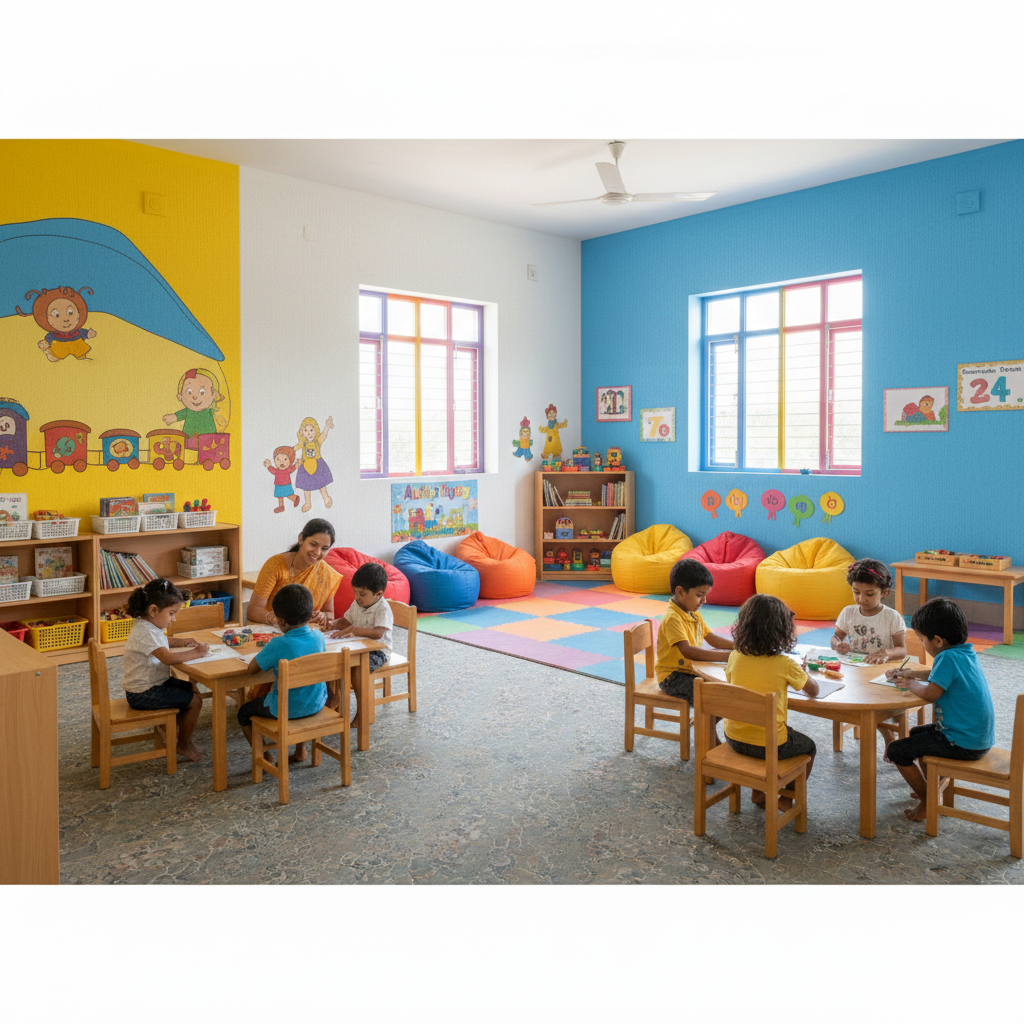
Early childhood education has evolved significantly over the years. Today, schools understand that young children learn best not through memorization, but through experience. Activity-based learning has become one of the most effective and scientifically supported teaching methods for children in Nursery, LKG, and UKG.
Instead of focusing only on books and worksheets, activity-based learning encourages children to explore, experiment, and engage with their surroundings. This method not only improves academic skills but also builds confidence, creativity, and social awareness.
Let us understand why activity-based learning is so important during the foundation years.
Activity-based learning is a teaching approach where children learn concepts through hands-on activities, games, storytelling, music, art, and group interaction. Instead of simply listening to instructions, children actively participate in the learning process.
For example:
This method makes learning enjoyable and meaningful.
Children remember things better when they experience them. If a child learns shapes by physically touching and identifying objects, they are more likely to remember those shapes compared to just seeing them in a book.
Activity-based learning connects concepts to real-life experiences. This improves understanding and long-term memory retention.
When learning feels like play, children absorb information naturally.
In Nursery, LKG, and UKG, children are developing their communication abilities. Group activities, role-play sessions, and storytelling exercises encourage children to express their thoughts clearly.
When children participate in activities like:
They overcome shyness and build self-confidence.
Confident children adapt better to future academic and social environments.
Creativity is a powerful skill that begins developing at an early age. Art, craft, music, and pretend play stimulate imagination and creative thinking.
When children draw, color, or build something with blocks, they are not just playing — they are learning to think independently. Creative activities help children:
Creativity nurtured early can lead to innovative thinking in later years.
In a structured classroom environment, children interact with peers of the same age group. Activity-based learning often involves teamwork and collaboration.
Through group activities, children learn:
These social skills are essential for healthy relationships in school and beyond.
Young children need to develop both fine and gross motor skills. Activity-based learning includes tasks that strengthen physical coordination.
Fine motor skills improve through:
Gross motor skills improve through:
Physical development is equally important as academic growth during early childhood.
One of the biggest advantages of activity-based learning is that it removes fear and pressure. Children do not feel burdened by heavy textbooks or strict memorization.
Instead, they feel excited to participate. A joyful learning environment creates a positive attitude toward school from an early age.
When children associate school with happiness, they develop a lifelong love for learning.
Activity-based classrooms allow children to make small decisions on their own. Whether choosing colors for a drawing or solving a simple puzzle, children learn to think independently.
This builds:
Independent thinking is an important life skill that benefits children in higher classes and adulthood.
Early childhood is a time of emotional growth. Activity-based learning provides opportunities for children to understand and express emotions.
For example:
When children learn to manage emotions early, they develop stronger emotional intelligence.
Nursery, LKG, and UKG are stepping stones toward formal schooling. Activity-based learning gradually introduces structured routines without overwhelming children.
By the time they move to primary school, children are already comfortable with:
This smooth transition reduces anxiety and improves academic readiness.
The early years shape a child’s attitude toward education. If children enjoy their early schooling experience, they are more likely to remain motivated and enthusiastic in higher classes.
Activity-based learning ensures that school is not seen as a place of pressure but as a space for exploration and growth.
When selecting a play school or kindergarten program, parents should look for institutions that emphasize activity-based learning rather than traditional rote memorization.
A school that balances academics with creative and physical activities helps children grow in all areas — intellectually, socially, emotionally, and physically.
The goal of early education is not to create toppers, but to nurture happy, confident, and curious learners.
Activity-based learning is one of the most effective teaching methods for children in Nursery, LKG, and UKG. It transforms education into an enjoyable journey rather than a stressful task.
By encouraging exploration, creativity, teamwork, and independent thinking, this approach lays a strong foundation for lifelong success.
Choosing an activity-based early learning program ensures that children develop not only academic skills but also confidence, communication abilities, and emotional strength — all essential for a bright and successful future.